This is not betting advice. It is the final note in a series about closing a research branch without a production candidate—and why that does not make the work equal to zero.
At the end of a long research project, two sentences are very tempting.
The first:
We found an edge.
The second:
We only need a little more tuning.
The second is especially convenient. It avoids a clean conclusion and always leaves room for another threshold, another window, another bookmaker, another filter, or a server that is allegedly one upgrade away from enlightenment.
We chose a third sentence:
No production candidate survived in the tested odds-only space. We are closing this branch.
Not the entire project.
Not sports analytics as a field.
Not the possibility of future mechanisms based on genuinely new information.
We are closing a specific route: repeatedly transforming the same bookmaker prices and hoping that one rearrangement becomes stable incremental knowledge.
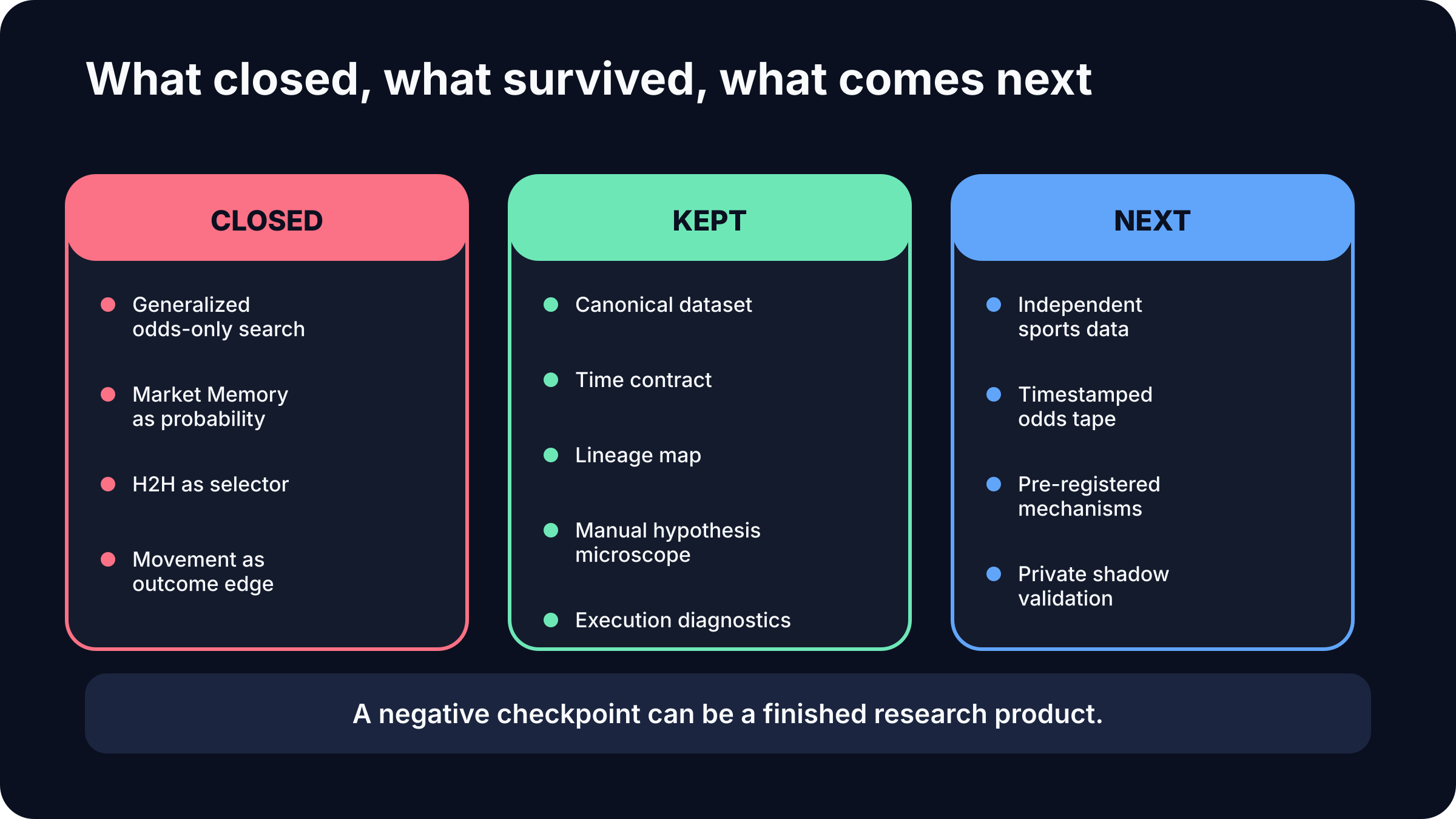
What exactly is closed
The generalized odds-only search is closed as a primary outcome-signal route across:
- Market Memory probabilities and edge derivatives;
- strict and overall H2H;
- source consensus;
- opening-price buckets;
- individual and global movement labels;
- historical movement context;
- cross-bookmaker disagreement;
- normal/anti reinterpretation;
- exact multi-condition samples;
- policy or threshold selection applied to broadly negative results.
This is not a philosophical claim that “the market cannot be beaten.”
It is an engineering checkpoint:
on the current dataset
with the current time resolution
under the current feature contracts
across fixed confirmation and rolling tests
production_candidate = NONE
The boundary matters.
We did not test every sport, every independent data source, every intraday price path, or every future hypothesis. We tested a defined family of transformations of bookmaker prices.
Inside that family, the work stopped producing new physics and started rearranging familiar parts.
That is where a laboratory should stop the branch—not because curiosity ended, but because the current material had answered the current question.
Why not search a little longer?
Technically, we could search forever.
We have 1,275 columns, thousands of values, 17 active Market Memory sources, multiple odds bands, normal and anti views, many time windows, and countless ways to connect three conditions.
If enough combinations are tested, positive rows must appear.
Randomness also knows how to use filters.
After a broad mechanism fails, an undisciplined continuation often looks like this:
one more source
+ move the threshold slightly
+ remove one bad month
+ keep only N >= 27
+ restrict DOG to a narrow price band
+ rename the survivor a candidate
That is not hypothesis testing.
It is a negotiation with history about which answer history should provide.
The almost-miraculous BWIN campaign showed the danger perfectly. The opening-price report was positive. The time-compatible closing-price report was negative. No amount of threshold decoration can repair a price that did not exist when the signal became knowable.
A kill gate belongs before the search becomes interior design.
What survived
The canonical dataset
We retained a reproducible MLB research object:
9,492 matches
1,275 columns
17 active Market Memory sources
unique non-null Match_ID
The strict Parquet conversion validated 891 numeric columns without introducing new nulls.
This is not simply a large table. It is a dataset where a field can be traced to its source, a row can be opened by Match_ID, and a transformation can be challenged without first reconstructing the author's mood that week.
The pipeline and data contract
The final pipeline separated:
raw input
→ threshold calibration
→ canonical preparation
→ historical features
→ labels and lineage
→ human review
→ strict Parquet
It fixed:
- one movement formula;
- individual and global scales;
EQUALseparate fromNO_DATA;- completed current-season matches inside calibration;
- explicit history partitions;
- a 12-hour match-centric embargo;
- opening-safe and close-proxy modes;
- a clear boundary between inputs and diagnostic targets.
A large project does not become trustworthy because it has many tests. It becomes trustworthy when its contracts are named and inspectable.
The time contract
The single most expensive lesson was temporal.
We now separate:
- what is known at open;
- what becomes known near close;
- what is known only after the event;
- which price belongs to each information state.
The +1.90% to −4.44% reversal was not a minor correction. It demonstrated that execution timing can dominate an attractive model story.
Future experiments need fields such as:
feature_available_at
signal_known_at
price_observed_at
price_executable_at
Without them, a backtest can acquire a time machine without declaring it in dependencies.
The lineage map
The 245 feature labels did not become 245 independent votes.
Only 109 were rule-enabled. Once aliases and complementary views were grouped, they represented 74 independent lineage families.
That map protects future work from the old illusion:
Five columns confirmed the signal.
When the five columns are WINS, TOTAL, FAIR_PCT, FAIR_ODD, and EDGE from one sample, they are five measurements from one witness.
The manual hypothesis microscope
We built tools that expose a hypothesis down to actual matches:
- exact historical sample;
- filter ladder;
- leave-one-condition-out;
- normal and anti;
- target and executable prices;
- price outliers;
- parent/child comparison;
- month and season distribution;
- sequential target campaign.
This is not a machine gun for generating rules.
It is a microscope.
A microscope is slower than spraying millions of combinations across the wall. It is also better at showing what is actually on the slide.
Execution diagnostics
Cross-bookmaker spreads did not become an outcome predictor. They did confirm the mechanical value of comparing prices.
Movement labels did not improve the closing outcome baseline. They did confirm that closing price was more accurate than opening price.
These results point toward a different value layer:
entry timing
source leadership
price routing
line shopping
CLV prediction
Sometimes the laboratory searches for a new engine and discovers that the immediate gain lies in reducing friction.
The public verification architecture—with an honest boundary
The public project produced useful commitment components:
- sealed files;
- hashes;
- manifests;
- archive snapshots;
- revealed records;
- result audits;
- an OpenTimestamps proof path.
In the July 21, 2026 fact check, all three archived public keys showed “timestamp not attached.” The architecture is real, but those specific archive entries did not contain attached OpenTimestamps proofs.
The sequence next time should be:
proven engine
→ private shadow validation
→ public signal
→ sealed commitment
→ attached and verified proof
A timestamp is a seal on an envelope.
The envelope still needs something worth sending—and the seal must actually be attached.
The lessons worth carrying forward
The market is a baseline, not stage decoration
A feature that beats 50% but loses to the no-vig price has not demonstrated incremental information.
Ranking and probability are different jobs
A feature can order strong states above weak ones while assigning inaccurate numerical probabilities. Useful description is not automatically a calibrated instrument.
One fixed split can be extremely charming
Several ideas looked interesting on one discovery/confirmation cut. Rolling 3M/1M and 6M/1M often reversed the result or selected zero feature weight.
If a hypothesis lives in only one time window, it may be renting the building rather than owning it.
Reducing a loss is not creating an edge
A filter can turn −5% into −1% by removing expensive exposure. That may improve execution or risk. It does not prove positive prediction.
Support is protection, not propulsion
70% at N=300 deserves more confidence than 70% at N=3. Large support still cannot rescue a weak mechanism. Sometimes it merely lets us reject it with better posture.
A negative checkpoint is part of the product
A research platform must know how to close branches. Otherwise every idea becomes immortal and eventually discovers a convenient threshold.
What is genuinely new enough to test next?
Independent sports data
Most current features are transformations of market prices:
odds
→ levels
→ movement
→ memory
→ consensus
→ differences
It is not surprising that price remains the strongest baseline when we try to beat it using derivatives of itself.
The next layer needs independent information:
- starting pitchers and confirmed lineups;
- bullpen load and player availability;
- rest, travel, and schedule context;
- weather and park factors;
- handedness matchups;
- independent team ratings;
- role changes and injuries.
Then the question becomes:
Does new information add value beyond the market?
Not:
Which new shape should we cut from the market itself?
Timestamped odds snapshots
Opening and closing prices are two points, not a price tape.
Without synchronized timestamps, we cannot prove:
- when a movement state became knowable;
- which price existed at that moment;
- which source moved first;
- whether apparent underround coexisted;
- whether a late pre-match execution strategy was possible.
A timestamped tape would support a genuinely different branch:
CLV direction
entry timing
source leadership
steam and drift detection
execution routing
This is not another rearrangement of current columns. It is a new data contract.
Pre-registered mechanisms
New manual hypotheses remain welcome, but they need to begin with a reason:
why this source-state
plus this independent context
should affect this target;
when the signal becomes known;
which price is executable;
what result closes the idea.
One hypothesis. One manifest. One campaign. One kill gate.
Globa approves fewer experiments this way.
Globa also saves more months.
What the Lab can become
The first public version spoke mainly in the language of a signal product.
The Lab can now speak in the language of evidence:
- what was tested;
- what failed;
- where leakage or stale price appeared;
- why attractive ROI disappeared;
- which contracts survived;
- what a genuinely independent next branch requires.
That is not a less interesting public story.
A laboratory that publishes rejected ideas clearly is rarer than another performance chart with a heroic gradient.
The Signal Archive can show that public history was not quietly rewritten. Lab Notes can show that the conclusions were not quietly rewritten either.
Final status
MLB_ODDS_ONLY_RESEARCH
status = NEGATIVE_CHECKPOINT
production_candidate = NONE

dataset = ACCEPTED
pipeline = ACCEPTED
time_contract = ACCEPTED
manual_hypothesis_tooling = ACCEPTED
execution_diagnostics = USEFUL
generalized_odds_only_search = CLOSED
This is not the ending we imagined at the beginning.
It is the ending we can trust.
We did not find “the” algorithm.
We found the point where tuning should stop, a method for separating signal from stale price, a laboratory that can reproduce its conclusions, and permission not to rename a negative result as a candidate.
Globa and AGI did not deliver a production edge.
They delivered something rarer: the ability to stop lying to ourselves—with a detailed report, a visible time contract, and enough self-irony to continue the work without turning the previous version into either a legend or a funeral.
May the Force of Globa and AGI be with us.
From now on, they have to show the table, the formula, and the price that existed at the time.